Webflow Templates vs AI Website Builders: Why the Market Changed
Template websites once owned the fast, affordable segment. AI builders changed that market, but they did not remove the need for strategy and structure.
June 24, 2026
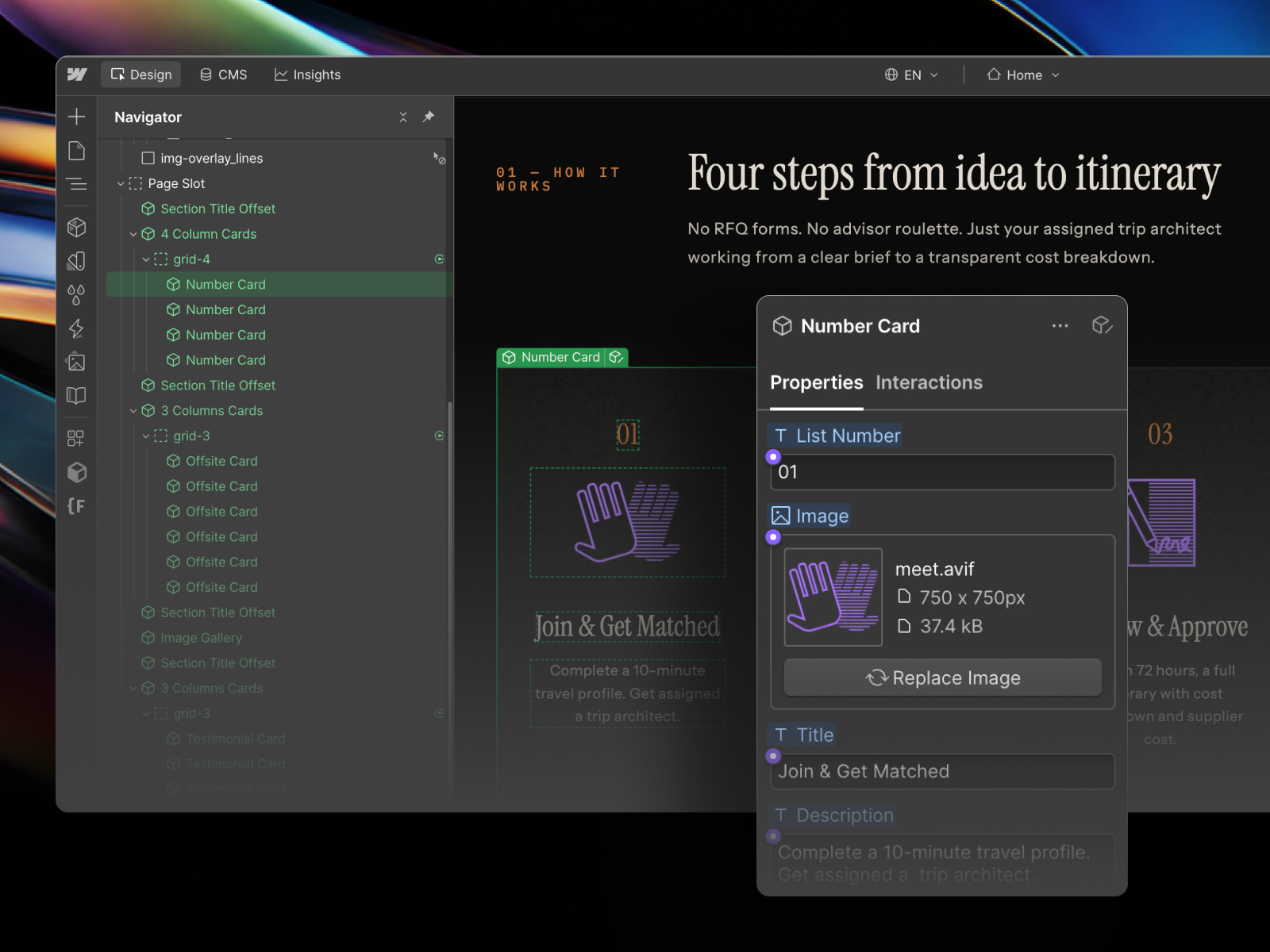
Template-based Webflow websites used to solve a clear business problem: a company needed a professional site faster and at a lower cost than a fully custom design.
For us, that was not a theoretical niche. Around $40,000 of our revenue in one year came from template-based Webflow projects. Clients received a stronger starting point, projects moved faster, and budgets stayed within reach for early-stage businesses.
Then demand changed. Over several months, we did not sell a single template-based project.
The decline was not simply a slow sales period. AI website builders and AI-assisted coding tools had started solving the same entry-level problem: “I need something presentable quickly so I can test my idea.”
Templates are not obsolete, but their position in the market is no longer the same.
Why Webflow templates worked so well
A good template reduced the amount of design and development work required before a business could launch.
It offered several advantages:
- A proven visual starting point.
- Responsive layouts that were already largely defined.
- Faster development than designing every page from zero.
- Lower project cost.
- A more professional result than most DIY builders.
For a company with limited budget, a template could bridge the gap between an improvised website and a custom engagement.
The model worked best when the client's content, sitemap, and brand could fit the template without forcing major structural changes.
What AI website builders replaced
AI tools lowered the barrier to producing a basic website even further.
An early-stage founder can now describe a product, generate an initial layout, rewrite copy, create supporting visuals, and deploy a working page without buying a premium template or hiring a specialist.
The result may not be strategically strong, technically clean, or scalable. It may still be sufficient for:
- Testing whether an audience understands an idea.
- Collecting early signups.
- Preparing a prototype for investors.
- Launching a temporary campaign.
- Creating an internal proof of concept.
This matters because the “fast and affordable” segment was exactly where templates had the clearest advantage. AI did not need to produce a perfect website to disrupt that segment. It only needed to produce something good enough for the client's immediate purpose.
The weakness of template-based projects was always hidden
A template can shorten production, but it does not remove the need for strategy.
Problems appear when the business is forced into a structure designed for someone else:
- The navigation reflects the demo company rather than the client's buying journey.
- Sections are retained because they look attractive, not because they communicate useful information.
- Important content is compressed to fit the existing layout.
- The CMS does not match the client's real content model.
- New page types require increasingly awkward workarounds.
- The visual identity remains recognizably template-based.
At that point, the team may spend so much time adapting the template that the original time and budget advantage disappears.
Where templates still make sense
A Webflow template can still be a rational choice when:
- The business has a small, stable sitemap.
- The available template closely matches the required structure.
- The goal is a credible launch rather than a distinctive category position.
- The client understands that customization will be limited.
- The website will not require complex CMS relationships or campaign systems.
- Speed and budget matter more than creating a unique design language.
The mistake is not using a template. The mistake is presenting a template as a substitute for product positioning, information architecture, conversion strategy, or scalable development.
Where AI website builders make more sense
An AI-generated site is often appropriate for a temporary or experimental need:
- A founder is validating a new offer.
- The product itself is not ready.
- The target audience is still uncertain.
- The page will likely be replaced after the first round of learning.
- The business cannot yet justify a strategic design process.
In that context, spending heavily on a permanent website may be premature.
AI enables the company to learn cheaply. Once the positioning, audience, and acquisition model are clearer, the business can invest in a website that reflects what it has learned.
Where a custom Webflow system creates more value
The market is moving away from paying primarily for page production. More value now sits in the decisions and systems that generic tools do not resolve automatically.
Positioning and information architecture
The website must explain the product in language buyers understand, prioritize the right messages, and guide different audiences toward relevant actions.
Reusable content architecture
Services, solutions, industries, resources, case studies, authors, locations, and related content should connect through a deliberate CMS model.
Scalable page systems
Marketing teams need components that let them launch landing pages without creating inconsistent new layouts every time.
Performance, SEO, and AEO foundations
The site needs crawlable content, sensible internal linking, metadata, structured data, clean redirects, image handling, analytics, and predictable technical behavior.
Post-launch ownership
A business website continues changing after launch. The client needs documentation, controlled editing, understandable structure, and a system another specialist can inherit.
These are core parts of our end-to-end website services and Webflow development work.
Template, AI, or custom: a practical decision framework
Choose an AI builder when:
- You are testing an idea.
- The website is temporary.
- The content and positioning are still changing radically.
- You need a first version more than a durable system.
Choose a template when:
- The template already fits the sitemap and content.
- The business needs a stable brochure-style site.
- Visual uniqueness is not a priority.
- The scope is controlled and unlikely to expand significantly.
Choose a custom website when:
- The website is a central marketing or sales asset.
- The business needs stronger positioning and differentiation.
- Multiple content types and audiences must work together.
- The marketing team will publish, test, and expand the site regularly.
- Long-term maintainability matters as much as launch speed.
The market did not eliminate professional website work
AI reduced the value of basic production. That is a real market change, not something agencies should dismiss.
It also made the difference between a generated page and a well-designed business system easier to see.
Companies no longer need an agency merely because they cannot put elements on a page. They need experienced help when the difficult part is deciding what the website should say, how it should be structured, how content should scale, and how the system should support the business after launch.
That is why our own positioning has moved away from “a website for every budget” toward structured websites for teams that need clarity, control, and room to grow.
See how that approach appears in our recent client work, or use the project form when a template or generated first version is no longer enough.